Book a call
Technical SEO Audit Service
Find the technical issues actually blocking your SEO and AI search growth. If we can't, you don't pay.
Our audit finds issues from two layers. The technical checks every site needs, plus a read on which fixes actually move your highest-value pages (not a hundreds of "issues" document you have to triage yourself).
- The full technical checklist, run against your live site
- Whether your highest-value pages are getting the internal authority they need to rank
- A fix list your engineers can ship as-is (so you're not stuck translating SEO for your dev team)
- Whether AI search engines can actually crawl, read, and cite your site


Trusted by growing brands






Are you facing these problems?
Google isn't indexing your new pages
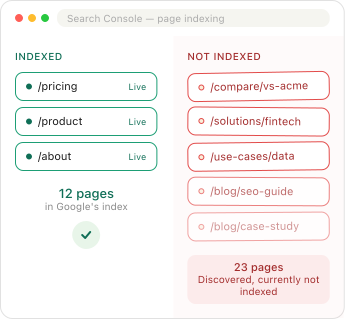
You publish a page and it just doesn't show up in Google. Sometimes it takes weeks, sometimes it never happens. If you open Search Console, you'll probably find a chunk of your site sitting in "Discovered, currently not indexed", which means Google knows the page exists but hasn't bothered to crawl or index it. The content is live, but as far as search is concerned, it isn't there.
Buyers ask ChatGPT but your pages are not even in their index
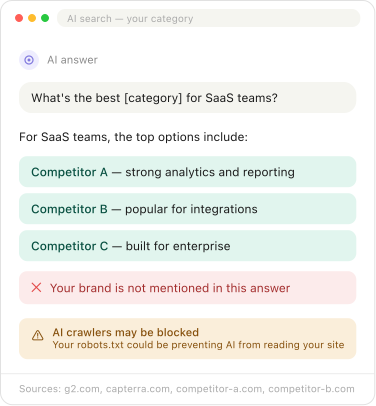
Your prospects now research in ChatGPT and Perplexity before they ever land on your site. When they ask about your category, the AI often points them to competitors, or describes what you do incorrectly. And most teams have no idea whether AI crawlers can even read their site in the first place, so there's no way to know why the answers are wrong.
Visitors land on your pages and bounce immediately
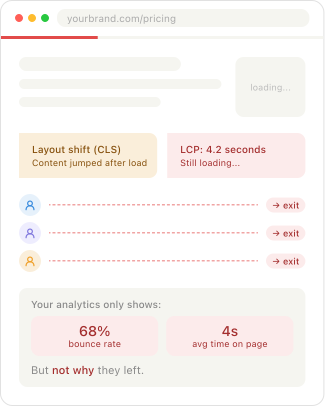
Traffic comes in but engagement stays low. Usually it's something on the page itself, slow loads, layout shifts, or pages that render broken on mobile. Visitors leave before your content gets a chance to land, and your analytics only shows you that they left, not what pushed them away.
Step 1: Cover the technical foundations every site needs
Every site needs these basics covered before anything else can work. We check all of it against your live site, then go after the issues a checklist can't catch.
Crawlability
Robots.txt directives
XML sitemaps
Indexation coverage
Crawl budget and log files
JavaScript rendering
Page speed
Core Web Vitals
Mobile usability
Site architecture and crawl depth
Internal linking
URL structure
Canonicalization
Duplicate content
Redirects and redirect chains
Broken links and 404s
Structured data and schema markup
Metadata (titles, descriptions, H1s)
Image optimization
HTTPS and site security
Archive and pagination
AI search readiness (GPTBot, ClaudeBot, PerplexityBot)
Step 2: Drill down to see whether your money pages get the authority they need
Not every page on your site carries the same weight. Your pricing, product, and category pages are the ones that close deals. Other pages don't.
So the thing that actually decides revenue isn't whether every page passes a technical check, it's whether the pages that close are getting enough authority to rank in the first place.
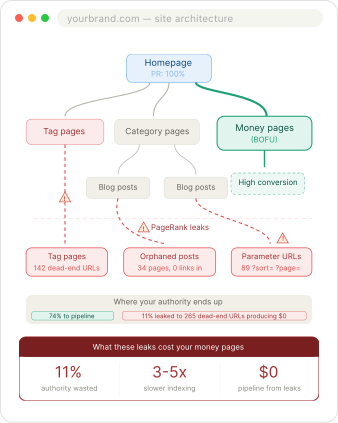
We study your site architecture to see how that authority (what Google itself calls PageRank) moves through it. The more a page holds, the faster it gets indexed and the harder it competes.
What we confirm is whether your architecture is tight enough for that authority to reach your money pages (the pages that actually produce pipeline). If it's leaking into tag pages, orphaned posts, and parameter URLs instead, we show you where, and how to fix it.
- A visual map of how authority moves through your site
- The internal linking changes that send more of it to your money pages
- A fix list your engineers can ship as-is (so you're not stuck translating SEO for your dev team)
Here's how we connect technical SEO audits to revenue
Real audits where the technical layer was the blocker, and what changed for the business after we fixed it.

How we cleared 1.3M crawl-wasted URLs and grew Leetify's organic traffic from 1.4M to 1.9M
- +37% Organic traffic
- -1.3M Crawl budget reclaimed
- 5.4x Top-3 rankings
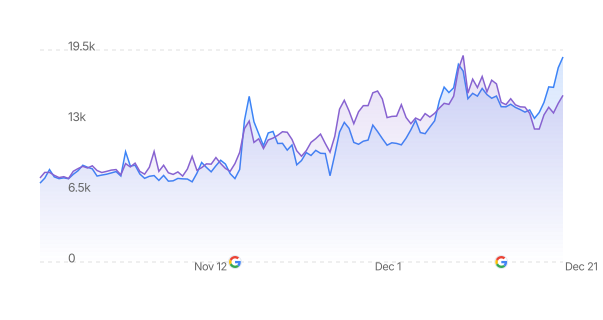
(1) How we cleared 1.3M crawl-wasted URLs and grew Leetify's organic traffic from 1.4M to 1.9M
When Leetify came to us, they weren’t starting from zero. It was the opposite - we saw a massive gamer performance analytics platform whose own scale was working against it.
Google was crawling the site millions of times a day but barely indexing it. Over half of its 200,000+ crawlable pages returned 3xx redirects. More than 555,000 low-value /match-details pages were indexed and barely earning a click. More than half of all pages needed 10+ clicks for Googlebot to even reach.
Staging and API subdomains were leaking into search results. And because the data pages rendered client-side, every page looked identical to Google on first crawl.
So Google's fixed per-visit crawl budget was being spent almost entirely on junk, and the pages that could actually rank (the data-rich ones) never got seen.
The content had the same gap. The site exposed crosshair data and little else, while CS2 players were searching for far more. A pro player's name plus their stats, settings, inventory, viewmodel, and rank.
Our solution
We led the full audit and strategy. Leetify's team shipped the fixes, and we ran the backlink campaign. The plan attacked the foundation first, then the content the demand actually wanted.
1. fix the technical foundation
We shipped a seven-point fix list. Block staging and API subdomains from indexing, correct canonical tags pointing at 3xx/4xx/5xx targets, repair 404s, streamline the redirect chains burning crawl budget, flatten the site architecture, and de-prioritize the 555,000+ /match-details pages.
The single highest-leverage fix was server-side rendering for the data-intensive pages. With SSR, Google could finally see unique, crawlable content instead of an identical client-rendered shell.
2. turn the data asset into pages the demand wants
Gamers who want to improve study the pros. Leetify already owned that data. It just wasn't exposed as rankable pages.
We templated SSR'd pro-player profiles and programmatic data-library pages (rank distributions, stats) around the "player name + intent" demand. With a median keyword difficulty of just 12, we picked fights we could win instead of bleeding on head terms.
3. fix anchor semantics with a backlink campaign
Across Leetify's entire backlink profile, only one anchor told Google the site was about "data," "stats," or "statistics." That's why competitors out-ranked it on terms like "cs stats."
We ran a backlink campaign built to give the homepage the semantic signals plain branded links never had.
The results
- •+37% - Organic traffic growth. Estimated organic traffic rose from 1.4M to 1.9M.
- •-1.31M - Crawl budget reclaimed. "Crawled, not indexed" URLs fell from 4,252,247 to 2,939,820 (a 31% drop).
- •+173% - Top-10 keywords. The tracked top-10 keyword set grew from 631 to 1,724.
- •5.4× - Top-3 rankings. Keywords in positions 1–3 grew from 66 to 359.
- •1,093 - Net-new rankings. Keywords now in the top 10 that didn't rank at all before.
- •135 - Brand-new ranking pages. Pro-player profiles and data-library pages that previously couldn't rank.
- •+21% - Search impressions. Up to 17.2M over the period.

How we recovered 20,217 deindexed pages and grew MachineHub's organic traffic 34%
- 20,217 Pages Re-indexed
- +34% Organic traffic
- 20x Top-3 rankings
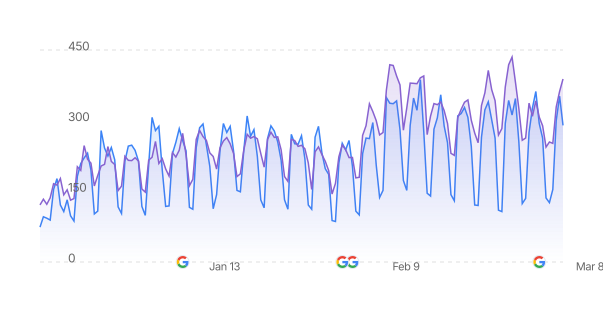
(2) How we recovered 20,217 deindexed pages and grew MachineHub's organic traffic 34%
MachineHub (an online marketplace for used industrial machinery) hit its organic traffic peak in 2024.
Then pages started dropping out of Google's index for no obvious reason, and traffic fell month after month.
The team hired an SEO consultant and followed the advice, but nothing turned it around.
By the time they came to us, more than 74,000 pages were stuck in the "crawled, currently not indexed" bucket in Google Search Console.
Our crawl (Screaming Frog plus the PageSpeed Insights API) showed why. The site was telling Google to throw its own inventory away:
- •303 type and brand pages on 302 "temporary" redirects to the homepage.
- •1,386 pages canonicalized to a different URL, including 37 collapsed into an "unknown brand" bucket.
- •527 /search and /listings pages served as JSON instead of HTML, with 10-second load times across most of the site.
- •1,739 broken 404 pages with live internal links still pointing at them.
Stacked together, these signals read as redirects, duplicates, and thin shells.
That is how a healthy marketplace quietly bleeds 20,000+ pages out of the index.
Our solution
This was never a content problem, so we did not treat it like one.
We advised and specified the work. MachineHub's developers shipped it (no new articles, no link building).
unblock the index. Fix the broken internal links, server-render the /search and /listings templates so they return real HTML, and clear the load-time bottlenecks.
re-prioritize the crawl. Add a fresh-listings sitemap (everything from the last 24 hours, priority 1.0, rebuilt daily) and re-score the type and brand sitemaps by listing count, so crawl budget flows to the densest categories first.
enrich with schema. Add Product, ItemList, CollectionPage, and a category-level AggregateOffer, the pattern that helps category pages win "used [machine] for sale" queries.
consolidate the architecture. 301 the legacy /categories/ pages into one /search/type/ pattern, with related machine-type links to spread crawl equity across the catalogue.
The results
Over the eleven weeks after the fixes shipped, the recovery showed up first in exactly the pages we had unblocked:
- •+20,217 pages indexed, from 42,901 to 63,118.
- •-19,501 "crawled, currently not indexed", from 74,287 down to 54,786.
- •+34% organic traffic, from ~25.9k to ~34.8k monthly visits (GSC impressions roughly doubled).
- •Top-3 rankings went from 5 to 103, with 438 more keywords ranking overall.
- •282 brand-new ranking pages, led by the same type and brand pages that had been redirected to the homepage.
What Our Clients Say About Us
Founders and operators who turned search and AI answers into a reliable growth channel.